
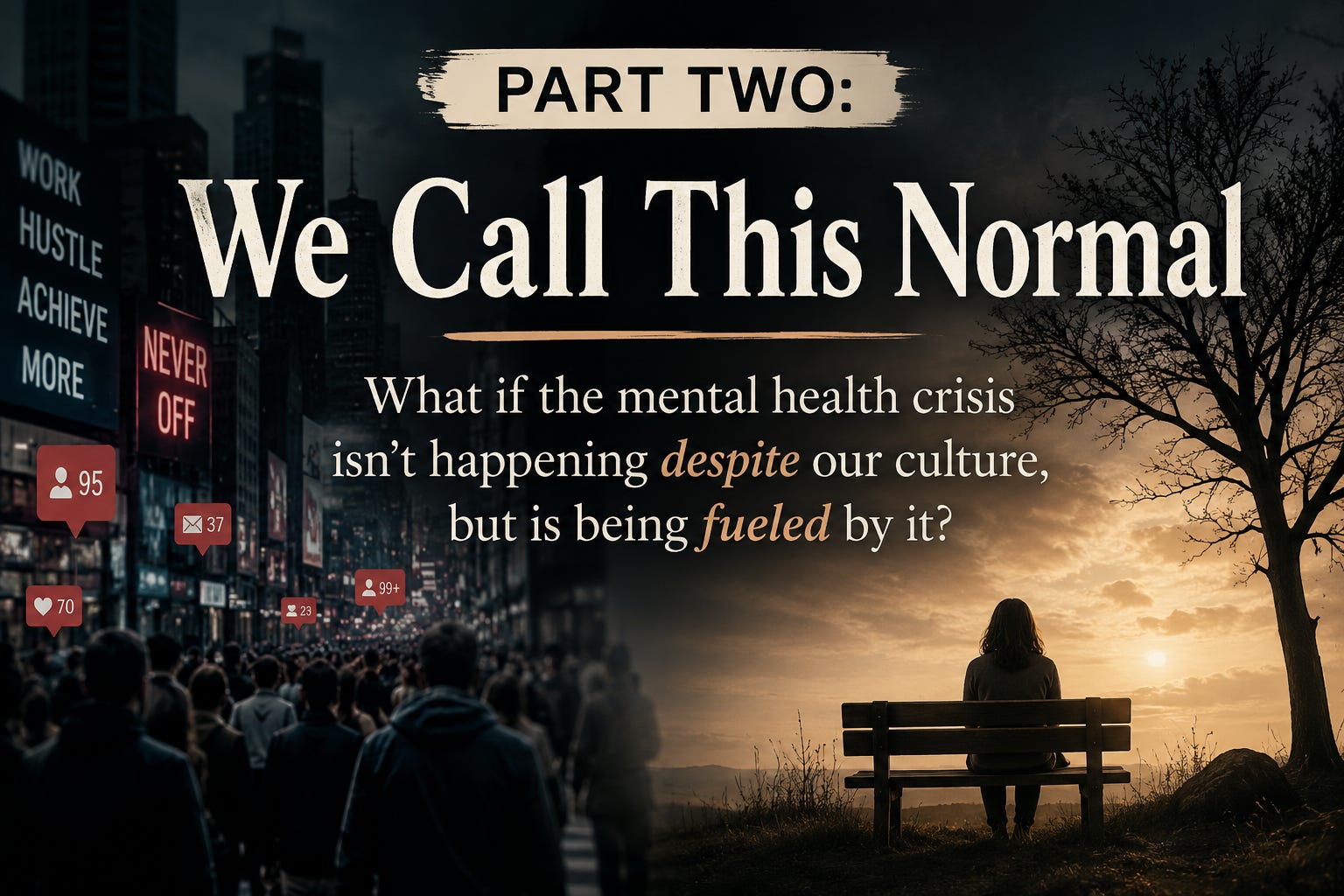
We Call This Normal
What if the mental health crisis isn't happening despite our culture—but because of it?

We Built a World That Never Stops
We didn’t get here overnight.
We built a culture that quietly removed every natural stopping point.
Stores never close.
Work never ends.
Technology erased the boundary between public and private life.
Childhood became a résumé.
Adulthood became a performance.
Aging became something to fear instead of honor.
Every season of life became something to optimize instead of experience.
The philosopher Byung-Chul Han argues that stress and exhaustion aren’t simply personal failures. They are social and historical phenomena. In The Burnout Society, he describes ours as an achievement society, where we are no longer driven primarily by bosses or institutions. We become both the employee and the employer, constantly pushing ourselves to produce more, achieve more, and become more.
The pressure isn’t just external anymore.
It’s internal.
We’ve learned to police ourselves.
We celebrate hustle.
We glorify being busy.
We feel guilty for resting.
We answer emails on vacation and call it balance.
We scroll through carefully curated lives and wonder why our own don’t feel like enough.
Modern consumer culture tells us happiness is always one purchase, one promotion, one accomplishment, one house, or one vacation away.
So we keep running.
Not because we’re lazy.
Because we’ve been taught that stopping means falling behind.
But here’s where I think we’ve been asking the wrong question.
People want one explanation for the mental health crisis.
Was it technology?
Capitalism?
Social media?
Parenting?
Schools?
Politics?
The answer is...
yes and no.
No single thing created the world we’re living in.
It’s layers.
Thousands of cultural shifts slowly began reinforcing one another until they created an entirely different way of living.
Think of it like a spider web instead of a chain.
A chain breaks when one link fails.
A web grows stronger with every strand.
Consumerism tells us our worth comes from what we own.
Technology makes comparison constant.
Work follows us home.
Parents overschedule because everyone else does.
Schools raise expectations because college admissions become more competitive.
Children lose free play.
Families lose dinner together.
Sleep decreases.
Loneliness increases.
Burnout becomes normal.
Mental illness rises.
No single strand causes the web.
Together, the web traps all of us.
That’s how cultures change.
Not because of one dramatic event.
But because thousands of small changes quietly reshape how we live, work, raise children, rest, connect, and measure our worth.
Which brings me to one of the greatest paradoxes of modern life.
We’ve never been more connected.
Yet we’ve never felt more alone.
For most of human history, people lived in small communities where survival depended on one another.
We shared responsibility.
We raised children together.
We grieved together.
We celebrated together.
We belonged to one another.
Today, many of us know our Wi-Fi password better than we know our neighbors.
We’ve traded community for convenience.
Presence for productivity.
Interdependence for independence.
Connection for comparison.
We’ve elevated self-sufficiency to such a high ideal that asking for help can feel like failure.
“Pull yourself up by your bootstraps.”
“Figure it out.”
“Hustle harder.”
“Be stronger.”
Those messages sound empowering.
Until they become isolating.
We were never designed to carry life alone.
We were designed to belong.
To grieve together.
To celebrate together.
To raise children together.
To grow old together.
Somewhere along the way, we confused independence with strength.
They are not the same thing.
Research consistently shows that chronic loneliness is associated with poorer mental and physical health, including higher rates of depression, cardiovascular disease, cognitive decline, and earlier mortality.
Connection isn’t a luxury.
It’s one of our most fundamental human needs.
Maybe that’s another strand in the web.
Maybe we’ve built a culture that celebrates independence while quietly starving us of belonging.
We used to measure wealth differently.
By time.
Time around the dinner table.
Time on the front porch.
Time with friends.
Time to grieve.
Time to celebrate.
Time to be bored.
Time to simply be.
Today, we measure wealth by productivity, possessions, and performance.
We have more conveniences than any generation before us.
We have less peace.
Burnout isn’t the disease.
It’s the smoke alarm.
It’s our nervous system telling us something about the environment we’ve created.
Our bodies were never designed to live in a constant state of urgency.
Yet millions of Americans wake up already behind.
They rush through the day fueled by caffeine, notifications, deadlines, and stress hormones, then collapse into bed too exhausted to connect with the people they love.
We call this normal.
Our biology does not.
Chronic stress elevates cortisol, fuels inflammation, disrupts sleep, weakens the immune system, and increases the risk of heart disease, depression, anxiety, addiction, and countless other chronic illnesses.
The consequences aren’t just emotional.
They’re physical.
Human beings have always worked hard.
This isn’t about hard work.
It’s about living in a culture where there is no finish line.
No season for rest.
No permission to be enough.
When your value becomes tied to what you produce, consume, and achieve, exhaustion isn’t an accident.
It’s the predictable outcome of the system itself.
Maybe burnout isn’t asking us to become more resilient.
Maybe it’s asking us to become more human again.
Because the opposite of burnout isn’t working less.
It’s remembering what we were working for in the first place.
YES: "Connection isn’t a luxury.
It’s one of our most fundamental human needs."
Absolutely!! Constant Nervous System Dysregulation leads to DIS-EASE.